Japan is fairly famous for public works that set out to spend government cash to stimulate the local economy. Since the bubble economy burst in the early 90s, government spending has been one way to keep Japan ticking over. In recent years tourism has finally increased to levels Japan deserves, which is helping rural areas revitalize their fortunes, but the legacy of public spending can be seen in the numerous tourist traps that lure bored locals on one of the many overcrowded public holidays.
Ushiku Daibutsu (Big Buddha)
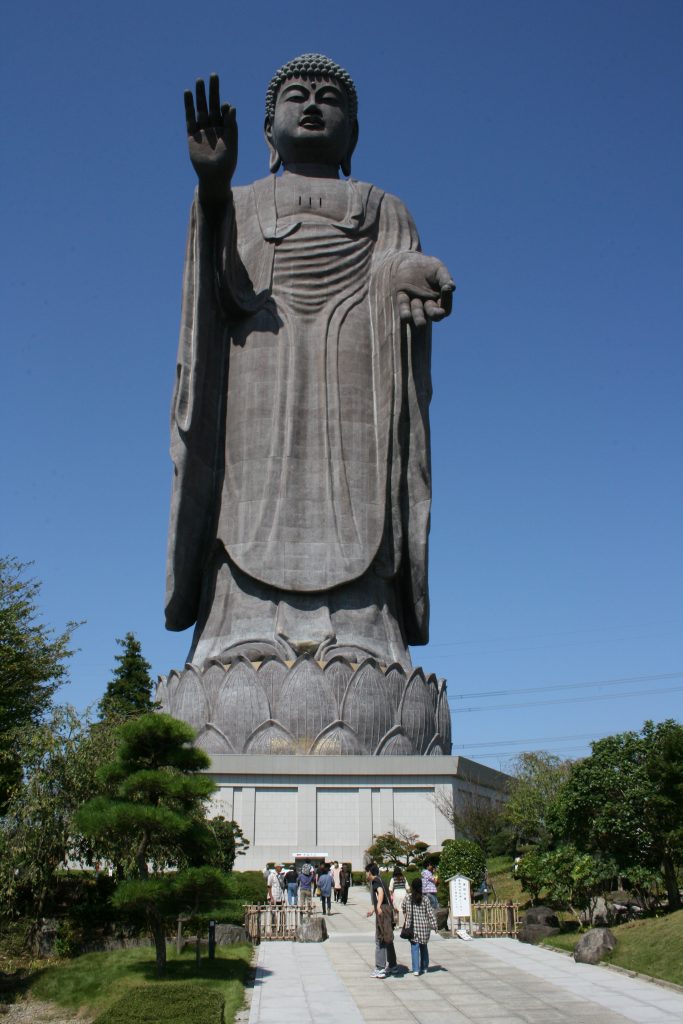
There is an article on “When Japan” about this already so we won’t go into too much detail here, apart from to reiterate that Ibaraki Prefecture (where the Buddha is located) is considered the most boring of all Japan every year, according to the Japanese.
Dragon God Big Suspension Bridge (Ibaraki)
So popular and famous it doesn’t have an English name or website (so “When Japan” made up the name), this is a literal “bridge to nowhere” that was built over a local dam for the soul purpose of allowing people to view the dam and bungee jump off the middle. While not the most egregious of fake reasons to turn a dam into a tourist spot (the area is beautiful, especially in the Fall), the stunning inaccessibility of the area to anything other than cars and the lack of sod-all else to do in the area make it something that foreign tourists with limited time should steer clear of.
Germany Village (Chiba)
This entry is a bit unfair as the “German Village” was clearly created with local families in mind as a way to entertain the children for a day, rather than as a tourist spot for anyone outside of Chiba prefecture, let alone foreign tourists. However, the awesome randomness of the various attractions and pointless theme of the main building’s “German aesthetic” (i.e. it’s not anything German at all) means it deserves a mention in this list. See the “When Japan” article for more details.
Kyoto Tower (Kyoto)
No one needs to look at Kyoto from above as by government decree no tall buildings are allowed above 31m (and in most locations this limit is a low as 12-25m). There is nothing of merit to see from such a high vantage point and the tower itself (topping out at 100m, which is 3 times anything else in the city) has received a fair amount of criticism for being an eyesore (and was build simply to compete with the Tokyo Tower, which was build 5 years before). The official homepage quotes the tower as “[…] symboliz[ing] a lighthouse illuminating the landlocked city of Kyoto”. As Kyoto itself, outside of the temples, is a typical ugly, grey Japanese city, perhaps a less illumination was in order, not more?